Travelling Beneath

Bodo (my beloved companion who mostly has the patience of Job) and
I are on our way back from the privilege of a road trip through our paradoxical
country to visit the biggest city we have, Johannesburg, and its neighbour
Tshwane (or should I still call it Pretoria?). It has been an inspiring trip.

It started with the opening night of the IMPAC film festival run by Pluto Panoussis and the Open Window school. We were exposed to the latest in exploratory film making. Some of the short films shown severely challenged my innate conservatism, but also stimulated my mind to transcend some of its well worn paths as a result of the startling imagery- for example: a man delicately stroking a barbel fish lying on a table wearing a collar (the fish, not the man) and the sound track following the contact of the finger with the fish!? Bravo Pluto for being such a pioneering and fine teacher – your film students take creativity to a new level and your guidance keeps it meaningful, although sometimes the meaning may be deeply personal.

We then had the privilege of three days in the Waterberg in the Welgevonden Game Reserve.  Although  covered in the brown coat of winter, the Waterberg shines as a relatively intact ecosystem. I know that without human intervention the lions would decimate the impala population to the brink of extinction (too many “big five” animals in too small a space), but there are butterflies galore. It was both thrilling and disturbing to come upon the 10 new teenage buffaloes being fed from cut open tyres on our way to the gate on the last morning.

We returned to the cities in order to do some work. I had some client meetings and a launch of my book Beneath in each city. I was reminded that affluent city people spend a lot of time in malls. Several times we were faced with the challenge of finding our way around unfamiliar malls and their parking lots. Our satellite navigation system was invaluable in negotiating the strangle of roads leading to the malls, but could not help us once inside the concrete boxes of our modern market places. Bodo (who has an innate sense of direction) invented creative ways of directing me as we rushed around preparing ourselves for my public appearances. I often had a sense of being a country bumpkin – not enough style or tech savvy to qualify for membership of the indefinable group that apparently thrives in this part of our complex country.

There were hard experiences:

  • Seeing the pathos of two tatty, yet still dignified elephants at the Joburg Zoo persistently curl their trunks into their inaccessible (by day) nighttime enclosure for a treat they could not quite reach.
  • Witnessing two dirty and mangy polar bears in their concrete enclosure listlessly half playing with one another.
  • Being continually surrounded and bombarded by advertising billboards and posters multiplying and enlarging in a nightmarish fashion. Billboards that proudly advertise themselves as offering in-your-face advertising (how could I miss it?!) and then having to think about my own bombardment of my network when they may feel intruded upon. We are all screaming “SEE ME, SEE ME!!!”
  • Watching the relentless and mindless destruction of habitat spreading like a cancer over the land, and knowing that at the same time the development is feeding many hungry mouths, and a good deal of greed.
  • Continually searching for the blue sky behind the brown haze.
  • Seeing the many poor and needy people at the side of the road and  more invisibly in the fragile homes of the urban sprawl and knowing that I am not able to help them.
  • Trailing my own heavy carbon footprint behind me as I went.

And yet, mostly, we encountered kindness and inspiration in a variety of forms:

  • The elderly pale faced proprietor of the men’s outfitters that sat behind his desk (defiantly smoking one cigarette after another)  berating his helpful scurrying staff members for not keeping him informed of the decision to quickly shorten my trousers for me, but who nevertheless winked and smiled at me as he gave me a discount.
  • The manager Marlize and the team at Exclusive Books (Brooklyn) who did a magnificent window display and pulled out all the stops to draw and host a great crowd for my launch of Beneath.
  • The many people who gave of their time to hear me speak about my passions and who asked meaningful questions which allowed me to display my wares (so to speak).
  • The connection with very special and longstanding friends who support me warts and all.
  • Treasured friends like Thapelo Mahlangu who went to great trouble (and risking his life while driving) to tell the world about my book and my activities.
  • The friendliness of staff at the variety of establishments that served us food and rooibos cappucino’s and the various courageous attempts at making red cappuccinos when such item was not on the menu.
  • The informative generosity of Owen Early, the book sales representative in Johannesburg who handles Beneath.
  • The woman at the beauty parlour who kindly, but bravely (and successfully) suggested an added grooming service.
  • The author (and past head of the Publications Board who was responsible for critical unbanning) who took the time to read and complement me on my book and attend my launch.
  • Candice and Marcia at Skoobs for supporting the launch of Beneath.
  • The past MBA students who connected with me in a variety of ways and reminded me of the joy of teaching and the privilege of fulfilling the role of a teacher in the world.
  • The SAB and Henley Business School team who asked Lewis Pugh to speak at the gala dinner for the delegates of their Management Development Programme and invited me and Bodo to attend.
  • Lewis Pugh, a great and compelling storyteller, who is crazy and determined enough to swim a kilometre at the North Pole in order to alert world leaders to the fact that we are causing the ice to melt at an alarming rate.
  • The women who cleaned our rooms at the various guesthouses and tidied my scattered possessions with care.
  • The people in Cape Town who kept the show on the road behind the scenes, my wonderful assistant Susan, careful and kind Samuel who brushed and walked Blackie (our remaining dog) every day, my publishing manager Dominique who keeps a watchful eye, Xavier my distributor who supported and delivered, and PR fairies Wendy and Sarah who keep me in mind when it matters.

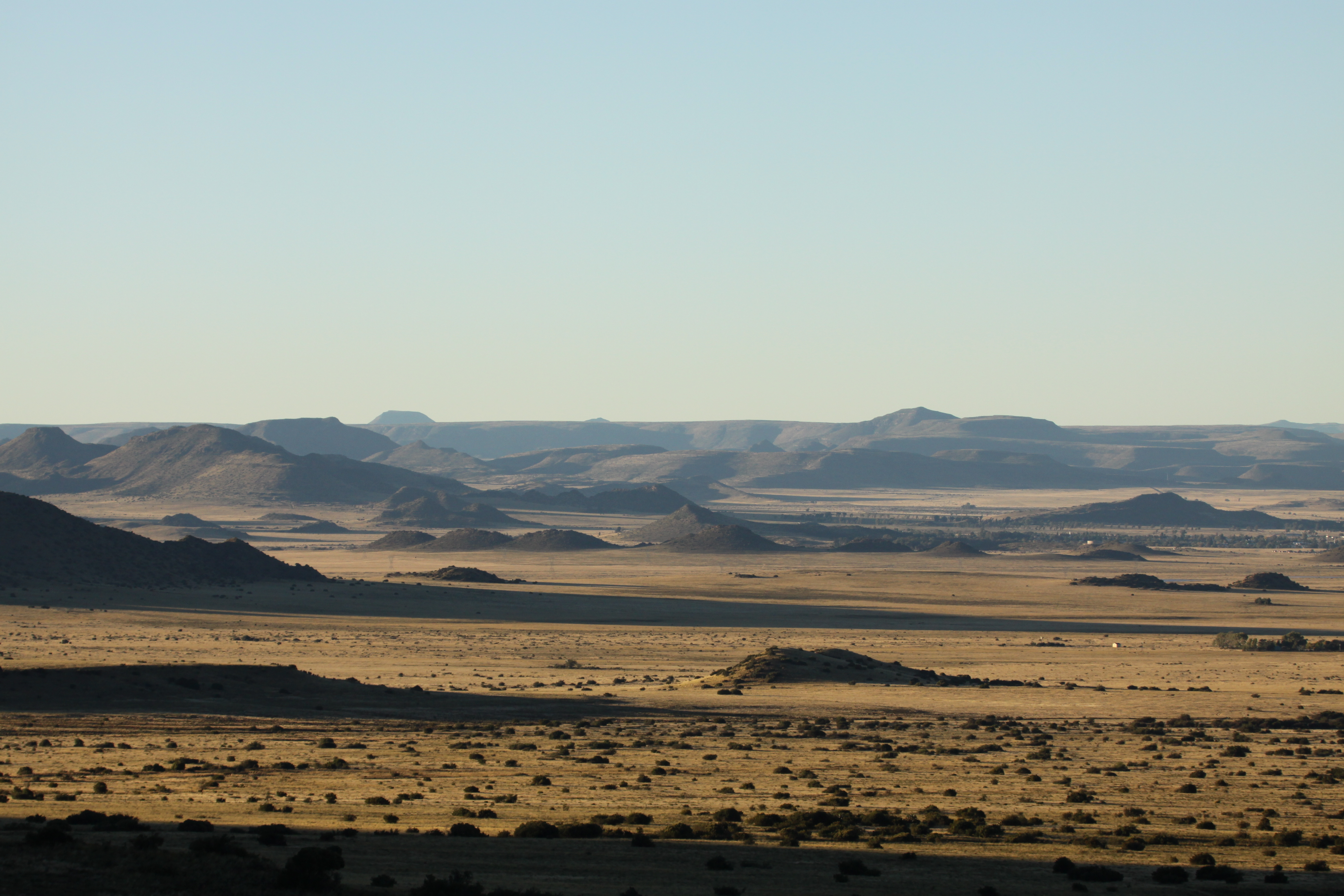
Of course, there was a lot more, but now there is the delight of the Karoo sky and the Pierneef landscapes beneath it on the way home.
The power of stories

We are on the road to Johannesburg from Cape Town driving through the beautifully barren landscapes of the Karoo. I love road trips for many reasons, but mostly because they give perspective to a life. There have been riots in London, the gold price is soaring, the ice is melting and yet life goes on. I woke up wondering (as I do sometimes) how we can make it all better. I know that I want us to clean up pollution, but for a person struggling to feed his or her children, or someone who has even abandoned that essential task out of utter hopelessness, the accumulation of plastic in the oceans simply does not matter. We are faced with many potentially irreconcilable dilemmas everywhere.  And so I think and think and think about how to take action that breaks through intractable world problems.

My main idea this morning is that it is critical for people to tell their stories (and to be heard) as a stepping stone towards caring for themselves, their communities and their environment. And so, for today, I decided to ask people their stories when I met them. The waitress at the Wimpy told me a little of her story. She  managed to become qualified in various aspects of hospitality despite having very limited resources. Hers is a story of determination.

I have been musing about how we can tell our stories whilst using our hands and also through our handiwork – making patchwork blankets, knitting, painting, crafting of one kind or another –  in a slower, older way of living and communicating and stitching the fragments of our lives into coherent wholes. And finally, thinking about how we can pay more attention to the untold stories of our unconscious minds, releasing the demons and discovering the magic that is sometimes stored there.

Beneath, Between and Beyond

Or Beyond, Beneath and Between?

I recently saw the film about Jane Goodall (I think it is called Jane’s Story) and it tells the story of her evolution from young chimp researcher to world environmental activist (see www.rootsandshoots.org for her work with young people worldwide). The film is understated and humble, and Goodall has a similar feel about her. I do not know much else about her and her work, but importantly, I was quietly, yet powerfully inspired. Goodall comments and seems to act on the idea of connecting human fulfilment with environmental goals, particularly working with children and youth.

I thought about my own work and its place in the world. As a result of such early Sunday morning thoughts, I finally formulated my BIG VISION, or so it seemed to me. In summary, I believe that we, as humans, need to have a three dimensional approach, including Beneath (inside us and our unconscious selves) Between (our relationships and resource sharing arrangements with others) and Beyond (the earth, the air, the oceans and the other species that live on our planet) and use all the creativity and technology at our disposal, in order to express ourselves as living beings; solve dilemmas and tensions that compromise bio- and psychodiversity; communicate virally;  and thereby take individual and collective action that is ecologically sound at the deepest level in order to ensure a thriving planet.

My radio interview

This week I was interviewed on Talk Radio 702’s Jenny Crwys-Williams show about my book Beneath. Stand-in presenter Leigh Bennie was not only extremely complimentary about the content and design of the book, but I was impressed by the extent to which she’d done her homework and asked really solid questions.

You can listen to the entire interview below, in two sections:

Vulnerability and the self-care system

Newborn waterbuck in Welgevonden
I watched the video of Brene Brown’s TED talk on The Power of Vulnerability this week as a friend kindly alerted me to it. The essence of her talk is that we need connection more than anything else and if we do not have it, we are miserable. However, in order to connect wholeheartedly with one another, we need to allow ourselves to be vulnerable. The main problem is that if our early caregiving has been inadequate in some way and not taught us how to be vulnerable or indeed that it is safe to be vulnerable, then it is a real bugger to learn how to be vulnerable.

Our psyches are phenomenally resourceful – if vulnerability was not welcomed or simply too dangerous in our early lives, then the psyche develops a precociously mature part that helps us survive and protects us from the world. However, that “Protector” part of us stays in charge into our adult lives and becomes a “Gaoler” to our vulnerable selves, even when it would now be safe to be vulnerable. Donald Kalsched in his brilliant (although technical) book called the Inner Trauma of Childhood – Archetypal Defenses of the Personal Spirit talks about the fact that children develop a “self-care system” that helps them survive unthinkable childhood trauma, but which also later on stops them from being vulnerable when it is required for connection.

Only a sustained, extremely compassionate and loving relationship with a very patient person is enough to dismantle the outdated self-protective, but ultimately dysfunctional, strategies of a person’s self-care system. And usually, only a therapist is that patient and self-sacrificing. It is helpful if the individual concerned can understand the problem and put his or her own “Protector / Gaoler” gently and gratefully out to pasture. It has taken me twenty years to do that, and I had a lot of help along the way.

Research to save the human race

I had the privilege of being invited to attend a day on research at UWC. I was kindly invited by Anita Maurtin-Cairncross from the UWC Human Resources Department to join a workshop which was aimed at developing research capacity. The Rector and Vice-Chancellor Professor Brian O’ Connell started the day by talking about the importance of research. He used the analogy of the Mayan people to emphasise that we as human beings are at risk if we continue unthinkingly along our path, and just like the Mayans, we may be facing extinction unless we can improve the sustainability of our situation. We are 7 billion people (and more every minute) on this planet.

I recently saw a film that showed a picture of our planet from outer space and I was struck by how fragile it looked from out there – this green and blue ball shrouded in strips of cloud just  hanging there in space. And I have been wondering about how long the planet can sustain 7 billion people and more. The earth is an ecosystem, and so surely it requires a certain amount of balance in order to continue sustaining life. Last year, I drove past Hartebeespoortdam. It is a luminous green and it is poisonous to humans. How long before we have made an environment that cannot sustain us anymore? Of course, the environmentalists tell us that we do not have long. What I find so astonishing is that so many of us, myself included (at least some of the time), live as if that is not true. We live as if we can continue consuming resources and producing waste as we are doing at the moment.

We can’t. We need research that tell us why human beings live in denial of glaring truths and we need research that tells us how to help ourselves wake up. I was impressed by the speakers at the UWC day. I think they are genuinely developing research capacity and I learnt a lot from them. I am pursuing my own research with renewed vigour. But I was left with a lingering discomfort because the time for research may be over.

Anger and repair

Anger is such a terrifying emotion.  Every now and then I become aware of feeling furious about something. It may be triggered by a seemingly inconsequential event such as an interaction with a rude customer service person, or more seriously by a random act of cruelty. Those reactive flashes of engagement with the world are still manageable, although unpleasant.

Sometimes, however, the thing that happens resonates at the core level of myself, reminding of a violation that occurred before I could fend for myself. And then, with the surge of a volcanic eruption, I become subsumed by the primitive ferocity of a threatened wild animal, and I pity those who stand in my way.  It is only later that I understand the dislocation in time and space, but by then the damage is done.

Training Dragons

I liked the symbolism in the film “How to train you dragon”. The basic story line is as follows: The Vikings regard dragons as enemies, because the dragons steal their sheep. A chief’s son injures a dragon without the knowledge of the village, but over time gradually heals and befriends the creature, coming to understand that the dragons are not evil, but are simply also trying to survive. In the process, the boy becomes disabled, but survives and wins the approval of his father and the village, resulting in a transformed relationship between Vikings and dragons.

I watched this film a while ago, but I often think about its story. As I mentioned previously, I have just published a book called Beneath – Exploring the Unconscious in Individuals which describes the arduous, painstaking and epic journey of integrating our unconsciously stored experiences into our conscious minds on an ongoing basis. I am continually asked what the simple message in my book is – in other words – what enlightening but easy-to-implement wisdom will transform people’s lives if they read my book? The answer is none. There are few easy answers to life’s problems and I do not include any in my book.

In a way, my book describes how to train our dragons. Training dragons is as difficult as it sounds and it may even mean learning to live with some disability of our own. Despite that, the process of training our inner dragons is transformative and likely to be deeply fulfilling. But it does require courage, stamina and perseverance.

I think many of us live lives of quiet desperation amidst a plethora of quick fix homilies and abundant, yet simplistic self help advice which does not work for us. I think we should be allowed to appreciate exactly how hard it is to break the destructive patterns handed to us by the generations before us (and magnificently refined through our own efforts in our own lives) and then be compassionately helped to keep going even when it’s tough.

The process of creative work

I have finally completed a book called Beneath – Exploring the unconscious in individuals that I have been working on for five years. It has gone to the printers and will be back in 4 weeks time, ready to be sold. For five years I thought about the book, spent hours and hours working on it, researching the subject matter, writing and rewriting words and sentences. During the process, I often imagined the joy I would feel when I finally finished. I was impatient to see the complete work and anticipated a feeling of great satisfaction. The anticipation kept me going when the work was tedious, which was thankfully not often. Most of the time, I was extremely motivated. I felt that I had something to say and that it was worth saying. I worked with an extremely talented designer, Pluto Panoussis, who ensured that the book was beautiful to look at and I was delighted as I watched the final product unfold. And then we sent it to the printers.

It has been very strange since then. I unexpectedly felt completely empty. I needed to start thinking about marketing the book and telling people about it, but the more I imagined what I would say, the less I could think of anything to say. I felt as if I have nothing more to offer. That is fortunately no longer the case, I am starting to reconnect with the wellspring of ideas inside me. But, the expected euphoria of completing a creative process did not manifest as I imagined. It was more as if I was compelled to allow the flow of the work through me, and then was exhausted and depleted by the process. To me it seems as if creativity is bigger than the human being who delivers it to the world, and that in the end we are merely vehicles for the life force. In retrospect, the biggest joy was the sense of being meaningfully occupied in the creative process itself, the joy of being an instrument that is being played.